
The 10% Rule Is Dead. Here's How to Actually Build Your Mileage.
The 10% rule has been widely used in the running world for decades. Only increase your weekly mileage by 10% at a time. Simple. Clean. Easy to follow.
There's just one problem: it doesn't work for most people.
Not because the principle is completely wrong — gradual progression matters. But because it reduces a complex, individual question down to a single number that ignores everything that actually determines whether your body can handle more training. Most runners don't follow it anyway. More is better, the thinking goes. If some mileage is good, more mileage is better. So they push, and they progress too fast, and then they get hurt.
I see this pattern constantly. Here's a better way to think about it.
Why the 10% Rule Fails
The rule only looks at one variable: total weekly mileage. But that number tells you almost nothing about what your body is actually experiencing.
When I assess whether a runner is ready to increase their training, I'm looking at all of this:
Current tolerance — how is your body responding to what you're doing right now?
Capacity — do you have the strength and tissue resilience to absorb more load?
Mileage — yes, total volume matters, but it's one piece
Terrain — hills, trails, and concrete all create different demands on the body
Intensity — a 40-mile week with three hard workouts is a completely different stimulus than a 40-mile week of easy running
Frequency — how often you run affects how much recovery your tissue gets between sessions
Experience — a runner with five years of consistent training handles progression differently than someone six months in
A runner who increases from 30 to 33 miles per week but adds a tempo run and switches from flat roads to hilly terrain has increased their load by far more than 10%. The math looks conservative. The body experiences something else entirely.
What Happened When Someone Ignored This
I had a patient who went from 25 to 50 miles a week in a matter of weeks. Doubled their volume. No gradual build, no adjustment period — just more miles because training was going well and motivation was high.
They developed a stress fracture.
And then — critically — they kept running on it instead of respecting what the bone needed to heal. Stress fractures require immobilization and a deliberate return to loading. Tissue has healing timeframes that don't care how good your fitness feels or how important your next race is. Running through a stress fracture doesn't just slow healing — it risks a complete fracture that sidelines you for months.
The injury wasn't bad luck. It was a predictable outcome of asking tissue to adapt faster than it physically could.
The Warning Signs You're Progressing Too Fast
Your body usually tells you before something breaks down. The problem is most runners either miss the signals or talk themselves out of them. Here's what actually matters:
Sharp pain that doesn't go away with rest — this isn't soreness, this is a signal
Pain that doesn't clear up with warming up — if you're still hurting at mile three, something is wrong
Pain that changes the way you run — if you're compensating, you're redistributing load onto tissue that wasn't prepared for it
No change in symptoms after 24 hours — if you ran yesterday and the same thing still hurts today at the same level, the tissue is not recovering
Any one of these means something needs to change before you add more.
A Better Framework: FDI
Instead of starting with a mileage target, start with these three variables in order:
Frequency first. How many days per week are you running? Adding a day of easy running before adding miles per session is often a safer way to build volume. It also keeps individual sessions manageable while the body adapts.
Duration second. Once frequency is established and your body is handling it well, extend the length of your runs gradually — starting with your easiest runs.
Intensity last. Hard workouts — tempo runs, intervals, race-pace efforts — should be the last thing you add and the first thing you reduce when something feels off. Easy miles build aerobic base and tissue tolerance. Hard miles stress the system. Both have their place, but the order matters.
The Actual Question to Ask
Instead of "can I add 10% this week?" ask: how is my body responding to what I'm doing right now?
If you're recovering well, sleeping well, your easy runs feel easy, and nothing is bothering you — you probably have room to progress. If you're consistently sore, something is nagging, or your easy runs feel harder than they should — that's a signal to hold where you are or pull back slightly before adding more.
Consistency over months and years builds durable runners. The athletes who stay healthy aren't the ones who train the hardest in any given week — they're the ones who've learned to read their own body and make smart decisions before things break down.
Not sure if your training load is where it should be? Book a free discovery call — I'll take a look at what you're doing and help you build a progression that actually holds up.
Should You Run Through Pain? Here's How I Think About It
It's one of the most common questions I get from runners: "Is it okay to run through this?"
The honest answer? It depends. Not all pain is created equal — and knowing the difference can be the thing that keeps you training versus sidelining you for months.
Here's how I think about it.
The 0-10 Pain Scale Rule
Rate your pain on a scale of 0 to 10 while running.
0-3: Generally okay to continue with modifications. Monitor closely.
4-5: Caution zone. Reduce intensity or distance. If it doesn't improve within a few minutes of running, stop.
6 and above: Stop. Running through this level almost always makes things worse.
If your pain increases as you run, stop. If it stays the same or decreases after a warmup, that's a better sign — but still worth getting evaluated.
Pain That's Usually Okay to Run Through
General muscle soreness from training (DOMS)
Mild tightness that loosens up after the first mile
Low-level achiness that doesn't change your form
Pain That Means Stop Now
Sharp, stabbing, or sudden pain
Pain that changes the way you run — if you're limping or compensating, your body is telling you something
Joint pain that gets worse as you run
Any pain that wakes you up at night
Pain that swells afterward
The Bigger Problem With "Running Through It"
Most runners don't get hurt from one bad run. They get hurt from weeks of ignoring small signals — tightness that became inflammation, compensation patterns that overloaded a different structure, fatigue that built up past what the tissue could handle.
By the time it becomes a real injury, there's usually a trail of warning signs that got ignored.
What To Do Instead
If you're questioning whether you should run through something, that question itself is worth paying attention to. A quick movement screen can tell you a lot — whether your tissue is actually irritated, whether you're compensating, and what you can do to keep training without making it worse.
You don't have to choose between running and recovery. The goal is to do both.
Have a pain you're not sure about? Book a free discovery call and we'll figure it out together.

Why Your Achilles Pain Keeps Coming Back (And What To Do Instead)
You rested it. You iced it. You stretched it. And yet, a few weeks back into training, the pain is back.
Here's why the standard approach keeps failing runners, and what actually works.
You took the time off. You iced it every night. You stretched your calf religiously before every run. And for a few weeks, things felt better. So you laced up, got back out there — and somewhere around mile two, that familiar tightness crept back in.
If you’ve been through this cycle more than once, you’re not alone. Achilles tendinopathy is one of the most common running injuries I see — and also one of the most mismanaged. Not because it’s complicated, but because the default advice most runners get sends them in the wrong direction entirely.
I had a client come to me after more than a year of this exact cycle. She’d seen other providers, tried rest, tried stretching protocols, tried running through it. Nothing stuck. After we completely changed the approach, she didn’t just return to running — she PR’d a marathon. Here’s what we did differently, and why it worked.
The Problem With Rest and Stretch
When something hurts, rest feels logical. And stretching feels productive — you’re doing something, you can feel it working, it temporarily relieves tension. The problem is that neither of these approaches actually addresses what’s driving the pain in the first place.
Achilles tendinopathy isn’t primarily a flexibility problem. It’s a load tolerance problem. Your tendon is being asked to handle more stress than it currently has the capacity to manage. Rest temporarily reduces that stress, which is why pain improves. But the moment you return to your previous training load, the tendon is right back where it started — still underprepared, still vulnerable.
Prolonged rest can actually make things worse over time. Tendons respond to load — that’s how they get stronger and more resilient. Remove the load completely, and the tendon can become more sensitive, not less. This is why so many runners feel great after two weeks off and then fall apart within days of returning to training.
The Root Cause: Undertrained Calves
The most consistent finding I see in runners with chronic Achilles issues is a calf complex that simply doesn’t have the capacity to handle the demands of their training. Not weak in the way most people think — they can walk fine, they can jog, they might even complete long runs. But when you test the tissue under meaningful load, the gap becomes obvious.
Every step you take while running loads your Achilles tendon. At easy paces that load is manageable. But increase your weekly mileage, add speed work, throw in some hills, or run on tired legs — and that load multiplies significantly. If the calf musculature and tendon don’t have the strength and resilience to absorb that stress, something breaks down. Usually the Achilles.
Two specific gaps show up again and again. First: most runners haven’t done any meaningful heavy calf training. Bodyweight calf raises don’t count — they’re too light to drive the kind of adaptation the tendon needs. Second: most runners have never trained their lower leg to handle the dynamic demands of running — the rapid deceleration and acceleration, the quick force absorption and release that happens with every foot strike.
What Actually Works: A Two-Phase Approach
The goal of Achilles rehab isn’t to reduce pain — it’s to build enough capacity in the tissue to handle the demands you’re placing on it. That requires a specific and intentional progression.
Phase One: Heavy Loading
We start with heavy, slow calf raises — weighted, challenging, performed both with a straight leg and a bent knee. This distinction matters. The straight-leg variation primarily loads the gastrocnemius. The bent-knee variation targets the soleus, which attaches lower on the Achilles and is often the more undertrained of the two. Both need to be strong. Both need to be loaded.
Heavy here means genuinely challenging — not three sets of twenty with your bodyweight. We’re looking for loads that require real effort and progress over time. This is what drives tendon adaptation. This is what builds the capacity that stretching never will.
Phase Two: Dynamic Loading for Running Demands
Once a solid strength base is established, we progress to dynamic loading — training the lower leg to handle the specific demands of running. Running isn’t slow and controlled. It involves rapid deceleration when the foot hits the ground, acceleration as you push off, and constant adjustments in force absorption depending on pace, surface, and fatigue level.
This phase includes exercises like pogo hops, jump rope, and bounding drills — movements that train the tendon to absorb and release force quickly. Most people skip this phase entirely, which is exactly why they return to running feeling strong in the gym but fragile on the road. The tissue has never been asked to do what running actually demands of it.
Keeping You Running Throughout
One of the most important parts of this approach is that we don’t stop running. Complete rest is rarely necessary and often counterproductive. Instead, we manage running volume and intensity based on symptom response — keeping load within a range the tissue can tolerate while we build capacity in parallel.
With my client, we didn’t pull her off running for a single week. We adjusted her volume temporarily while we built her calf strength, then reintroduced harder efforts as her tolerance improved. She trained through her entire marathon prep. She ran her race. She PR’d.
That’s not a miracle. That’s what happens when you stop managing symptoms and start building capacity.
The Bottom Line
If your Achilles pain keeps coming back, the cycle isn’t bad luck. It’s a predictable outcome of an approach that treats the symptom without addressing what’s driving it. Rest gives you a window. Loading closes it permanently.
The answer is progressive, intentional loading — building the calf and tendon up to handle what you’re asking of them. Heavy strength work first. Dynamic loading to prep for running demands second. Smart management of your training volume throughout. It’s not complicated, but it requires actually doing the work rather than waiting for the pain to disappear.
If you're a runner in Dallas dealing with Achilles pain that keeps coming back, book a free 15-minute discovery call. We'll figure out what's driving it and build a plan that actually fixes it.
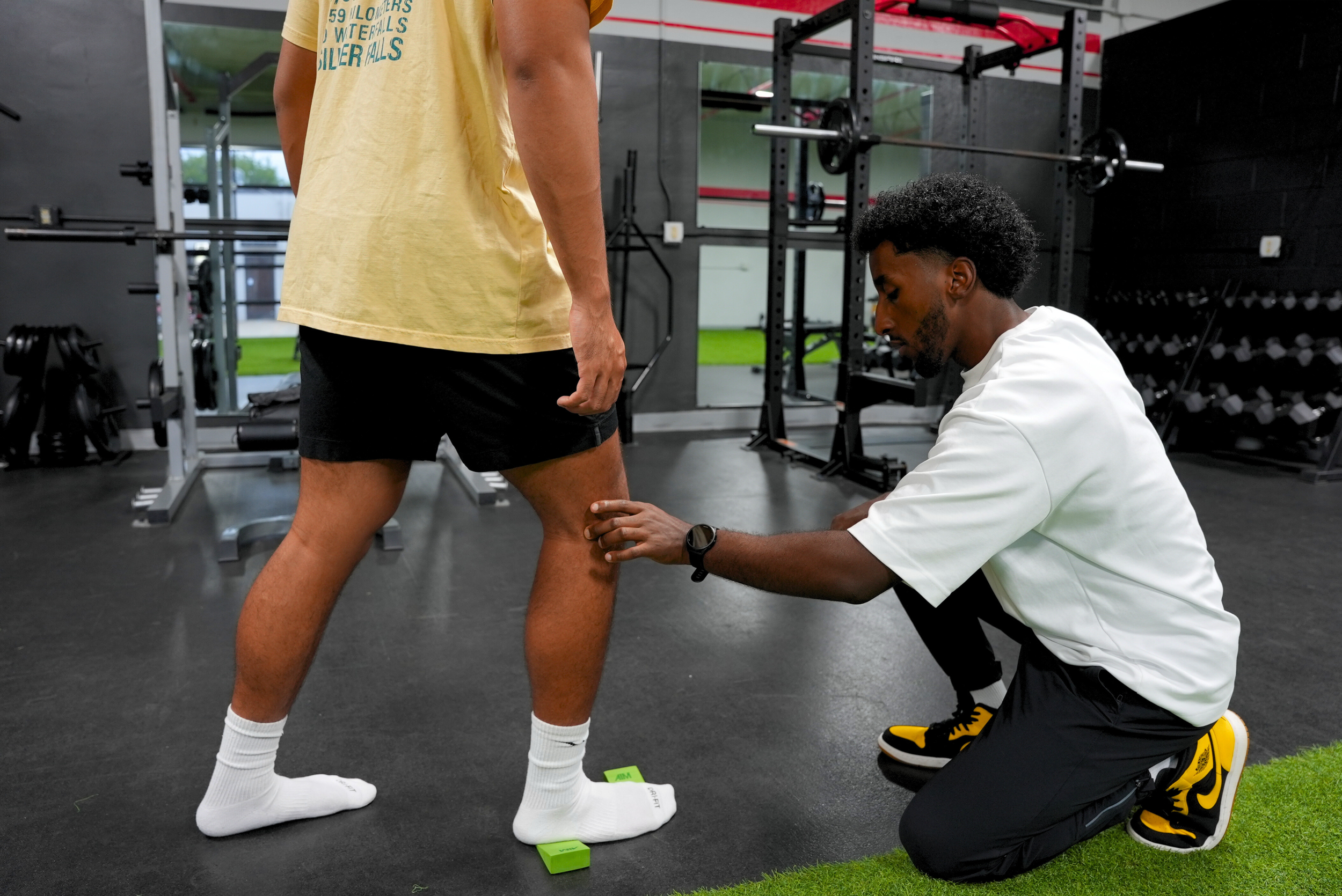
How To Know When Pain Is Okay To Train Through
Pain shows up and most athletes do one of two things: push through or stop completely. Both extremes cause problems. Here's the framework I use to make a smart decision in the moment.
Pain shows up during a run or a training session, and suddenly you’re faced with a decision that most athletes handle poorly. Either you push through completely — convincing yourself it’s just soreness, just tightness, nothing serious — or you stop everything, rest for a few days, and then come back at full intensity before anything has actually changed.
Both extremes cause problems. Pushing through pain that shouldn’t be ignored leads to bigger injuries. Stopping at every sign of discomfort keeps you perpetually undertrained and behind where you want to be. What you actually need is a framework for making a smart, informed decision in the moment — one that doesn’t require guessing.
This is the framework I use with every athlete I work with.
The Myth That’s Keeping You Stuck
The most common advice when pain shows up during training is some version of: stop, rest, ice, take some ibuprofen, and wait for it to calm down. This approach has become so embedded in athletic culture that most people follow it automatically, without questioning whether it’s actually the right call.
Sometimes it is the right call. But most of the time, for the kinds of nagging pains that show up in healthy runners and gym athletes, it’s not. Here’s what actually happens: pain settles during rest. The athlete feels better. They interpret “feeling better” as “ready to train,” return at the same intensity they were at before, and the pain comes back — often worse than it was originally.
I had a patient who did exactly this. Something was bothering him and he rested for a few days, felt fine, went back to full training — and came back to me with the pain significantly worse. Rest had reduced his symptoms without doing anything to address the underlying issue. The tissue wasn’t more capable. It was just less irritated. Those are very different things.
What Pain Is Actually Telling You
Pain is your body’s way of communicating that something needs attention. It doesn’t automatically mean stop — it means pay attention. The question isn’t whether you feel pain. It’s what kind of pain, how much, and how your body is responding to it.
There’s also a neurological dimension to this worth understanding. Your brain doesn’t simply receive pain signals passively — it actively constructs the experience of pain based on context, past experience, and expectation. Two athletes with the exact same tissue damage can feel completely different levels of pain depending on what they believe about it, what they’ve been told, and what’s at stake for them. This doesn’t make the pain less real — it makes the relationship between tissue and experience more complex than a simple signal-and-response.
All of which is to say: pain requires interpretation, not just reaction.
The Three-Point Framework
When pain shows up during training, I assess it against three criteria. If all three are satisfied, continuing to train — with awareness and possible modification — is generally safe. If any one of them isn’t, something needs to change.
1. Pain stays below a 3 out of 10, during and after training.
On a zero-to-ten scale, zero is no pain and ten is the worst imaginable. A three or below during activity is generally tolerable and not a sign that damage is occurring. Equally important is what happens after: if pain is at a two during your run but spikes to a six afterward and stays elevated into the next day, that’s a signal the tissue isn’t handling the load well. The during and after both matter.
2. No major change in function or movement mechanics.
If pain is causing you to significantly alter your gait, avoid loading a limb, or compensate in ways you wouldn’t normally, that’s a problem. Compensation patterns are how a minor issue becomes a major one. The body is remarkably good at offloading a painful area onto surrounding structures — structures that may not be built to handle that extra demand. Training through pain that changes how you move is a reliable way to accumulate a second injury while trying to manage the first.
3. You’re still progressing overall in strength and tolerance.
If pain is present but your capacity is still improving week over week — you’re getting stronger, your tolerance for load is increasing, your performance isn’t declining — that’s a green light. The trend matters more than any single session. If pain is present and you’re also getting weaker, slower, or more limited over time, something needs to change in the training plan.
When to Modify Instead of Stop
If any of those three criteria aren’t met, the answer usually isn’t complete rest — it’s modification. Reduce the load. Shorten the session. Swap a high-impact movement for a lower-impact variation. Change the surface, the pace, or the volume. The goal is to find a level of activity the tissue can tolerate while you address whatever is driving the problem.
Complete rest is sometimes necessary — but when it is, it should be strategic and short-term, followed by a deliberate return-to-training plan rather than just going back to what you were doing before. The tissue doesn’t get stronger from rest. It gets stronger from progressive loading. Rest buys you time. Loading builds the capacity to use that time well.
The Bigger Picture
The athletes who train consistently over years and decades aren’t the ones who never feel pain. They’re the ones who know how to interpret it accurately and respond to it intelligently. They don’t panic at every twinge, and they don’t ignore signals that matter. They’ve developed a relationship with their body that allows them to make good decisions in the moment rather than defaulting to either extreme.
That kind of literacy takes time to develop — and it’s one of the most valuable things working with a good PT can accelerate. Not just treating what’s hurt, but building the understanding of your own body that keeps you training for the long run.
If you’re a runner or gym athlete in Dallas dealing with pain that keeps interrupting your training, book a free 15-minute discovery call. We’ll assess what’s actually going on, give you a clear framework for managing it, and build a plan that keeps you moving.